Tuesday, 25 September 2012

Mary Anning Weekend

The weekend of the 29th and 30th September is part of the Mary Anning Week event at the Lyme Regis Museum, Dorset.  Mary Anning was a prolific fossil collector who discovered several very well known marine reptiles from the Jurassic rocks and cliffs around Lyme Regis.  She also discovered one of the first recorded English Pterodactyles.
This specimen of Dimorphodon macronyx (then Pterodactylus macronyx) was collected from the Undercliff in the Lower Jurassic Blue Lias at Lyme Regis.  It was described by the Reverend Willaim Buckland in his 1829 paper and the specimen now resides in the Natural History Museum, London.


Several other specimens were found in the Lias following this discovery, including a skull, two tails and a near complete skeleton.  The skull, also now in the Natural History Museum, was drawn by Mary's brother Joseph, using reconstituted belemnite ink from the cliff fossils.  This early drawing is now in the Lyme Regis Museum.
Other illustrations have since been done using this method of ink drawing.  The Annings made a good living selling fossils from the Liassic Cliffs around Lyme.  Many of them can be found in museums around the UK and some have been sent to overseas customers.  The Plesiosaurs and Ichthyosaurs are perhaps their most dramatic finds from this time.


Saturday, 1 September 2012

Old Photographs

A couple of days ago I received an enquiry about photographs of some of the obscure type specimens - the sort of fossils that are outside of the main stream of research because they are generally fragmentary remains.  To see if I could provide such photographs I searched my collection of images.  Very little joy in that search as I could only find two of the images, and they were of poor quality.  This inspired me to do a bit more with my negatives.
I do have some old photographs which go back to 1975 and they are mostly kept as negatives or 35mm slides.  This mandible of Rhamphocephalus was taken at the Natural History Museum, London, in 1976; then the British Museum of Natural History. It is digitised from a black and white negative using a film copier and it has remained good after 36 years in storage.
This image is of the upper and lower mandible of Istiodactylus in the University Museum of Zoology, Cambridge, taken in 1986.  The picture was taken using a cheap colour positive film and the chemistry of the slide has changed, degrading the image significantly.

Time is important in protecting old images.  The digital versions may often be less pixilated than good quality film images, but they do not degenerate in the same way.  I now keep all of my digital images on a separate hard drive in two files, my copyright and other peoples copyright.  This drive is backed up an a secure separate hard drive on a monthly basis and most of the images are also stored on a DVD disc.  This ensures that in the event of a crisis, some images will be preserved.

In my office are two boxes of slides and negatives which still need to be digitised.  Some have degraded considerably and may well never be recovered.

I am now looking for photographic images of the following specimens;

Natural History Museum, London
R176 Istiodactylus latidens
37002 Rhamphorhynchus longipes
42735 (Pterodactylus pulchellus) Pterodactylus micronyx
37990 (Pterodactylus longicollum) Diopocephalus longicollum
1640 (Cimoliornis diomedeus) Ornithocheirus diomedius

Sedgwick Museum, Cambridge
B54.443 (Ornithocheirus brachyrhinus)
B54.437 or B54.438 (Ornithocheirus carteri)
B54.499 (Ornithocheirus crassidens) Amblydectes crassidens
B54.544 (Ornithocheirus dentatus)
B54.444 (Ornithocheirus enchorhynchus)
B54.644 (Ornithocheirus eurygnathus) Amblydectes eurygnathus
87822 (Ornithocheirus huxleyi) Lonchodectes oweni
B54.835 (Ornithocheirus platystomus) Amblydectes platystomus
B54.440 (Ornithocheirus polyodon) Seeley 1870
B54.441 (Ornithocheirus scaphorhynchus) Lonchodectes scaphorhynchus

If you have such images that you are willing to share, please send them to pterosaur@ntlworld.com

Sunday, 5 August 2012

Searching on-line Part Two

The Pterosaur Database is now on-line in a limited form.  The listing of museums with pterosaur specimens and the listing of collection material has been put on-line in a test format.  The data still needs some adjustment, but it is available for the first time for everyone to search.
The first search up is the specimen search, where you can enter the name of a species or genus and see what comes up.  The data search gives basic information like description, museum and catalogue number as well as a few notes in some cases.


It is also possible to search by specimen type and by Museum.  The museum search is in two phases - firstly the general information search by country, key name words and town/city.  A second search page gives a choice of matches, and a selection of the record number presents a specimen list, as shown below;

First page requiring general information.
Second page giving a choice of matches.
Third page showing the museum list of specimens, postal address, contact telephone number and website where available.

There are several museums with pterosaur material that are represented by only type and figured specimens.  Some museums that hold pterosaur material have not been visited and are therefore not included here.

This database is a read only system to protect the data at source. However, a parallel database has been set up into which new specimens can be added.  When the input has been verified, the entries will be included in the main database.  Corrections can also be entered here by adding the correct entry and describing the alteration in the Notes field.

Any comments on the functionality of the on-line system will be appreciated in order to adapt it to the needs of users.

Wednesday, 25 July 2012

Bibliography on-line

For a few weeks, the current bibliography of The Pterosaur Database has been tested on-line.  It is now up and running in its current form, enabling the listing and printing of publications from a database file.
The records are extracted from a SQL database by a simple request program which was written specifically for this purpose.
Just enter an authors surname, part of a title or a date and see what comes up on  the list.
Searching for 'Bennett' brings up 47 publications from a current file set of 1438 records.

The data on this database cannot be amended or added to as it is a static file.  However, we are running a parallel database which can be interrogated and added to.  The data will be verified at intervals and where appropriate, transferred to the main database.  This will prevent corruption of the master database whilst allowing people to add new papers and texts for inclusion.
Feel free to comment on the functionality of the database.

Thursday, 7 June 2012

Host Migration

The Pterosaur Database is moving to www.pterosaur.org.uk hosted by UK Web Hosting (Enix Ltd).  The website framework is now running and all of the database search elements should be in place by August.

It is good to have a host that responds rapidly to problems and provides skilled advice and support.  There are a few re-write issues to be resolved as the server structure is different to the previous server for which the website was designed.

Thursday, 24 May 2012

The On-line Database Problem

Since February 2012 I have been unable to load data to the on-line database files on the Pterosaur Database.  This has been a concern for some time and I have tried to progress this issue with 1and1 to find out how they are moving on with the server error that is blocking the file uploads.

Unfortunately, the support desk of the company is set up to act as a firewall between the customer and the server administrators.  The server is in Germany and the support desk is in the Pillipines.  This is an on-going problem and after 4 attempts to enquire about progress, this is the best response so far:-

"Thank you for contacting us.

We sincerely apologize for the inconvenience that this has 
brought you,we have already informed our higher department 
regarding how urgent thiscase to be resolved.
And as of the moment they are doing there best to have this 
resolved atthe back end of the server. Once they are able to
find the cause for thisissue and have this fixed then we will 
sent you an email update for this.We understand that you 
might be anxious to have this resolved as soon as possible 
so thank you so much for your patience while we working on
the resolution.

If you have any further questions please do not hesitate to
contact us."

The first update enquiry response 3 days ago, when they had already replicated the error on two previous occasions was:-

"Thank you for contacting us.

We have tried testing in importing database composing of
2 data and it gonethrough. What is the data file size that 
are you trying to import?

If you have any further questions please do not hesitate to 
contact us."

I must say that for years, 1and1 have provided excellent service.  But now, the new support desk is a wast of time.  Each enquirey contact is treated as a new problem by a different opperative. The opperatives generally have a poor grasp of the English Language and they are limited in what responses thay can give.  The general policy seems to be - ask the customer a question, then the enquiry will come back to someone else - it is essentially a "pass it around" culture with no single point of contact responsibility.  When I have asked for the enquiry to be read by a supervisor, the response has been a further question.

My advice is, if you want to use databases on-line, avoid using 1and1 at present.

The datasets, I am sure, will eventually be uploaded, but there is no timescale for the completion of the on-line data.


Sunday, 20 May 2012

A tail

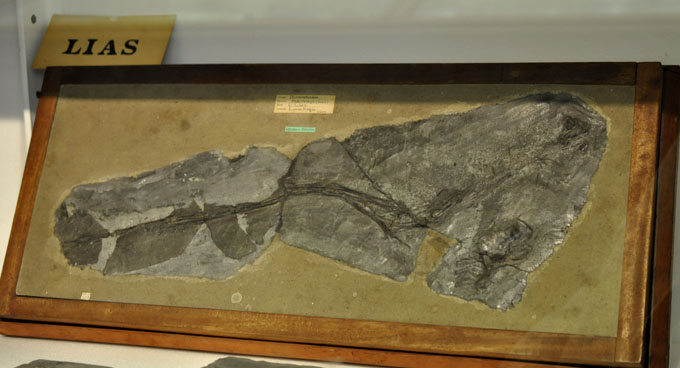
 Within the collections on display at the Sedwick Museum, Cambridge is a specimen of a Dimorphodon macronyx tail.  This is catalogue number J.61175 and is part of the Whinborne Collection.  The fossil is from Lyme Regis in Dorset and may have been collected by Mary Anning from the Lower Lias of the Undercliff.  The tail is in a state of dissociation and may be the rotting offcast from a predators meal.
Removing the bones photographically from the matrix shows the caudal vertebrae and the stiffening rods that would have kept the tail rigid in life.  There is also some material on this slab that looks like a sternum fragment.  It is not easily defined from a photograph.  If there was a cartilage running from the sternum to the tail, this would not be an unusual association.

The only other tail of Dimorphodon macronyx is in the Natural History Museum, London.  Specimen number 41349 is a complete and rigid tail with all of the stiffening rods in their natural place close to the vertebrae.  The arrangement of rods is similar to that seen in Rhamphorhynchus.

The long tail of this type of pterosaur would have been used as a balancing organ and would most probably have had a vertical sail at the tip to give the animal directional stability when flying. The sail is only seen in some Rhamphorhynchus specimens where wing membrain is preserved.  Dimorphodon does not show this degree of preservation.